Showing posts with label sculpture. Show all posts
Showing posts with label sculpture. Show all posts
Saturday, 7 May 2011

Friday, 6 May 2011
Arnaldo Pomodoro in Dublin.
In April I went on a short trip to Dublin. Whilst there we stumbled across a sculpture within the Trinity College campus. It was by Arnaldo Pomodoro, an Italian sculptor whose work I also saw at last year's Sotheby's exhibition at Chatsworth House. The sculpture at Trinity was one of many 'Sphere Within Sphere' sculptures which are dotted around the globe. Unlike 'Cubo I' at Chatsworth', 'Sphere Within Sphere' is a kinetic sculpture, designed like this possibly because of it's spherical shape, which is easier to move than solid cuboid shapes.
![]()
![]()
![]()
![]()


Saturday, 30 April 2011
Anish Kapoor - Flashback. Exhibition Review.
Anish Kapoor, Flashback Exhibition at Manchester Art Gallery. 29th April 2011
The first exhibition solely dedicated to the work of Anish Kapoor outside of London features sculptures and installations made from pigment, wax, stone and stainless steel. Personally I think these materials collaborate well together, rather than fight for attention in the same room. The first sculpture I came to was 'Moon Shadow' 2005, made from wood, wax and an oil-based paint. I liked this sculpture as I felt it had a hidden drama to it; the wax and paint mixture made it look like it was still wet and had only been flung up onto the wall moments ago, the viewer is witnessing the few seconds before it falls from the wall and becomes a different piece of work entirely. The suspense and tentative nature of Kapoor's works makes them distinguished against other artist's.
"I don't wish to make sculpture about form - it doesn't really interest me. I wish to make sculpture about belief, or about passion, or about experience that is outside of material concern." Anish Kapoor 1981
'Turning the World Inside Out' 1995, made from stainless steel is a welcome piece amongst the sculptures made from wax and pigment. The reflective nature of the steel works well with the bold colours such as red, and yellow in the room. I feel the sculpture is quiet in form; smooth curves of steel seem humble against the spikes of the pigment and wax pieces. For me, the title of 'Turning the World Inside Out' seemed the most literal of all. The sculpture could be the world itself; turning inside out and imploding. Or it could be turning the world which surrounds the sculpture turning inside out. Due to it's reflective nature, it seems to be sucking inward the surrounding environment.
'When I am Pregnant' by Kapoor, 1992, made from fibreglass, wood and paint, blurs the lines between work and gallery so much, this sculpture almost goes unnoticed. A subtle bump in the wall of the gallery, it is only really seen from the side, if this sculpture is looked at from straight on, it almost completely disappears as it is painted perfectly into the gallery wall
'Void' 1994, fibreglass and pigment, was another favourite of mine. A dome, which reminded me of half an egg-shell shape, had a deep purple exterior and a blackened interior. It is obvious to see that to get colour of this depth and intensity, pigment was Kapoor's only choice. The title of void, comes from the uncertainty of the blackened interior. When looking at this sculpture I studied it hard to decide whether it was a flat surface or if it did in fact curve inwards; the intensity of the colour makes this unbearably hard to figure out. With Kapoor's work, the voids envelope the viewer.
'White Sand, Red Mullet, Many Flowers' 1982, mixed media and pigment, was what looked like the centre-piece of the exhibition. In the centre of the room, the sculptures looked like sandcastles of pigment, in red, yellow, and black. His use of pigment is clearly directly influenced by his Indian heritage and upbringing in India. The sculptures look like sandcastles that are precise and accurate in form. They look soft and crushable yet their form and structure appear strong. I like the visible tension between soft materials and solid forms.
The first exhibition solely dedicated to the work of Anish Kapoor outside of London features sculptures and installations made from pigment, wax, stone and stainless steel. Personally I think these materials collaborate well together, rather than fight for attention in the same room. The first sculpture I came to was 'Moon Shadow' 2005, made from wood, wax and an oil-based paint. I liked this sculpture as I felt it had a hidden drama to it; the wax and paint mixture made it look like it was still wet and had only been flung up onto the wall moments ago, the viewer is witnessing the few seconds before it falls from the wall and becomes a different piece of work entirely. The suspense and tentative nature of Kapoor's works makes them distinguished against other artist's.
 |
| 'Moon Shadow' |
"I don't wish to make sculpture about form - it doesn't really interest me. I wish to make sculpture about belief, or about passion, or about experience that is outside of material concern." Anish Kapoor 1981
'Turning the World Inside Out' 1995, made from stainless steel is a welcome piece amongst the sculptures made from wax and pigment. The reflective nature of the steel works well with the bold colours such as red, and yellow in the room. I feel the sculpture is quiet in form; smooth curves of steel seem humble against the spikes of the pigment and wax pieces. For me, the title of 'Turning the World Inside Out' seemed the most literal of all. The sculpture could be the world itself; turning inside out and imploding. Or it could be turning the world which surrounds the sculpture turning inside out. Due to it's reflective nature, it seems to be sucking inward the surrounding environment.
 |
| 'Turning the World Inside Out' |
'When I am Pregnant' by Kapoor, 1992, made from fibreglass, wood and paint, blurs the lines between work and gallery so much, this sculpture almost goes unnoticed. A subtle bump in the wall of the gallery, it is only really seen from the side, if this sculpture is looked at from straight on, it almost completely disappears as it is painted perfectly into the gallery wall
'Void' 1994, fibreglass and pigment, was another favourite of mine. A dome, which reminded me of half an egg-shell shape, had a deep purple exterior and a blackened interior. It is obvious to see that to get colour of this depth and intensity, pigment was Kapoor's only choice. The title of void, comes from the uncertainty of the blackened interior. When looking at this sculpture I studied it hard to decide whether it was a flat surface or if it did in fact curve inwards; the intensity of the colour makes this unbearably hard to figure out. With Kapoor's work, the voids envelope the viewer.
 |
| 'Void' |
'White Sand, Red Mullet, Many Flowers' 1982, mixed media and pigment, was what looked like the centre-piece of the exhibition. In the centre of the room, the sculptures looked like sandcastles of pigment, in red, yellow, and black. His use of pigment is clearly directly influenced by his Indian heritage and upbringing in India. The sculptures look like sandcastles that are precise and accurate in form. They look soft and crushable yet their form and structure appear strong. I like the visible tension between soft materials and solid forms.
 |
| 'White Sand, Red Mullet, Many Flowers.' |
Thursday, 7 October 2010
Beyond Limits, Sotheby's at Chatsworth House.
An Exhibition Review: Beyond Limits Sculpture Exhibition at Chatsworth House.
Every autumn, Chatsworth House gardens become the location for ‘Beyond Limits, Sotheby’s at Chatsworth: A Selling Exhibition.’ This year there were 24 sculptures dotted around the grounds, some by new sculptors, and some Sotheby’s favourites such as; Damien Hirst, Lynn Chadwick and Marc Quinn who have been previously exhibited.
‘Contemporary Terracotta Warriors’ is a group of identical sculptures by Yue Minjun, inspiration taken straight from the famous Terracotta Army which were found in pits near a burial ground in China’s Shaanxi province. The sculptures are in rows of four, stood on different levels of the Cascade allowing them to be viewed in its entirety as an installation or group. The expression is typical of Minjun’s work, an almost manic laughter; mouth wide open and eyes closed. However, they all have their hands covering their ears which turn the laughter into a cry or wail; this brings to attention the horrors of war.
Another favourite is ‘Visitor’ by David Breuer-Weil. This is a large head of a man half immersed in the Strid Pond, this makes me think a huge man’s body is underneath the surface of the water, walking up to shore and about to come onto dry land. The Strid Pond is surrounded by a variety of plants and leaves, creating a jungle effect in my mind, a place where huge people and unusual animals could actually exist.
http://www.sothebys.com/
http://www.sothebys.com/app/live/event/EventEduDetail.jsp?event_id=29093
Every autumn, Chatsworth House gardens become the location for ‘Beyond Limits, Sotheby’s at Chatsworth: A Selling Exhibition.’ This year there were 24 sculptures dotted around the grounds, some by new sculptors, and some Sotheby’s favourites such as; Damien Hirst, Lynn Chadwick and Marc Quinn who have been previously exhibited.
Lynn Chadwick had an impressive collection of four separate sculptures this year. All metal pieces, there was one named ‘Ace of Diamonds III’ and three representative of women. My favourite two were; ‘High Wind IV’ and ‘Ace of Diamonds III’. ‘High Wind IV’ shows a woman caught in a high wind by her horizontal sweeping skirt and hair. However, she is armless. This creates a streamlined figure, which I find emphasises the strong breeze. The bent knees also add to this, as if struggling to find footing against the gale. Every sculpture in this exhibition has its own carefully selected location to compliment the sculpture’s characteristics. This metal, grey-coloured piece stands out among a backdrop green. The rotating ‘Ace of Diamonds III’ really benefits from being situated upon water as the reflections almost become part of the sculpture. ‘Stairs’ is situated across the Ring Pond from ‘High Wind IV’. Another feminine sculpture, this one is a set of three steps with one woman walking up, and the other walking down and crossing on the middle step. Again, armless figures but they have triangular prisms instead of a human head. Chadwick’s final piece is titled ‘Three Elektras’ these are three figures, armless, triangular prisms instead of heads and three legs, similar to a stool. The sculptures are made from a grey-green metal finish, but part of the head and the front of the torso is shinier, polished gold. The angular features and soft shaped gardens in the Rockery create juxtaposition for the sculptures to really become fore-figures and stand out.
 |
| 'High Wind IV' |
 |
| 'Ace of Diamonds III' |
 |
| 'Stairs' |
 |
| 'Three Elektras' |
Thirteen out of the twenty four sculptures are human figures. Ju Ming had two sculptures, both bathing women named ‘Swimming’. I liked these figures; I found the poses they hold to be very life-like, one is lying down sunbathing and seems totally relaxed. They have prime position in the garden, just in between the Rockery and the Strid Pond. This immediately transports the sculptures to a tropical rainforest, two women in bathing suits, relaxing on rocks heated by the sun, and thinking about diving into the cool water below.
 |
| 'Swimming' |
 |
| 'Swimming' |
Manolo Valdes’ ‘Butterflies’ is of what is presumed to be a woman’s head, with hair made from, or a crown of jumbled butterflies. The stunning backdrop for this piece is the back of Chatsworth House. Although large and made from metal, the escaping butterflies give a slightly fragile and delicate appearance to the entire sculpture. The butterflies twisting in all directions catch the sunlight and provide lovely bright reflections.
 |
| 'Butterflies' |
 |
| 'Butterflies' |
‘Contemporary Terracotta Warriors’ is a group of identical sculptures by Yue Minjun, inspiration taken straight from the famous Terracotta Army which were found in pits near a burial ground in China’s Shaanxi province. The sculptures are in rows of four, stood on different levels of the Cascade allowing them to be viewed in its entirety as an installation or group. The expression is typical of Minjun’s work, an almost manic laughter; mouth wide open and eyes closed. However, they all have their hands covering their ears which turn the laughter into a cry or wail; this brings to attention the horrors of war.
 |
| 'Contemporary Terracotta Warriors' |
Another favourite is ‘Visitor’ by David Breuer-Weil. This is a large head of a man half immersed in the Strid Pond, this makes me think a huge man’s body is underneath the surface of the water, walking up to shore and about to come onto dry land. The Strid Pond is surrounded by a variety of plants and leaves, creating a jungle effect in my mind, a place where huge people and unusual animals could actually exist.
 |
| 'Visitor' |
A peculiar sculpture I found is Johan Creten’s ‘Why Does Strange Fruit Always Look So Sweet?’ Situated in the Rockery this is a man covered in what seems to be the ‘strange fruit’ from head to knees. This has made me think that perhaps a man was enticed by the strange but sweet looking fruit but the man gets covered by the fruit almost entirely when he tries to take some. This reminds me of the story of Adam and Eve being tempted by the serpent to eat fruit from the Tree of Knowledge of Good and Evil. The strange fruit is sweet looking because of the temptation surrounding it; however if someone takes it there will be a bad consequence.
 |
| 'Why does Strange Fruit always look so Sweet?' |
A regular at the Beyond Limits Exhibitions at Chatsworth House, Damien Hirst this year has produced ‘Saint Bartholomew, Exquisite Pain’. This sculpture is the most religious. Saint Bartholomew was one of the Twelve Apostles of Jesus, a missionary in India and he died by flaying and crucifixion. Flaying is being skinned alive, preferably with the skin staying in one complete piece, Bartholomew the Apostle died a martyr hence Hirst’s title of ‘Exquisite Pain’. However Hirst has introduced a modern twist compared to the religious images from hundreds of years ago; instead of holding a knife like Saint Bartholomew is often depicted, he is holding a large pair of scissors. Considering the theme of pain, this sculpture has been carefully placed in the Sensory Garden.
 |
| 'Saint Bartholomew, Exquisite Pain' |
Near the Canal Pond, are two sculptures by Zadok Ben-David; ‘Leftover’ and ‘You Again’. They are two large copper coloured, 2-dimensional, Corten steel men. The men are incomplete silhouettes; they are made up of what appears to be tree branches. They seem lonely near the pond, two people contemplating life as they wander aimlessly around the calming water.
 |
| 'Leftover' |
 |
| 'You Again' |
Marc Quinn is another artist who has been involved in past Beyond Limits Exhibition. In previous years I have seen his ‘Sphinx’ sculpture of supermodel Kate Moss. This year he is showing two sculptures as one piece called ‘The Engine of Evolution’. At first appearances they are two large, completely white flowers. But the title proves they are more than a botanical installation. Each flower holds similarities to male and female genitalia, giving meaning to the title ‘The Engine of Evolution’.
 |
| 'The Engine of Evolution' |
 |
| 'The Engine of Evolution' |
As you walk from the Canal Pond towards to House, you come across ‘Eve’ by Richard Hudson. The name and twisting curves suggest a womanly shape to this metal sculpture. I particularly like the many reflections on the glossy finish and I find it a particularly good photographic subject.
 |
| 'Eve' |
 |
| 'Eve' |
Barry Flanagan has exhibited at Chatsworth House before, with and without the Sotheby’s Exhibition. His ‘Large Mirror Nijinski’ is two hares posing, dancing almost, opposite each other. Flanagan’s work often features hares. The hares are placed in the Cottage Garden, each surrounded by their own circular bed of flowers which become part of their circular base.
 |
| 'Large Mirror Nijinski' |
‘Hungry God’ by Suboph Gupta is a large collection of aluminium pots and pans housed inside one of the garden’s greenhouses. Once again I like the use of polished metal for the twisted and unreal reflections, and the use of these items bring to thought kitchen utensils and food, in particular excessive food waste as the sculpture is like a tidal wave of waste.
 |
| 'Hungry God' |
 |
| 'Hungry God' |
Contemporary architect and furniture designer Ron Arad produced ‘Rod Gomli’, situated in the Rose Garden, the placement makes the chair seem it belongs in a terrace in a sunnier clime. The chair is like a raindrop shape, or perhaps a leaf or a pod, the natural shapes the chair conjures up makes me think that this chair belongs outside rather than in a living room. The lines throughout the chair really exaggerate the curves and shape of the whole sculpture.
 |
| 'Rod Gomli' |
 |
| 'Rod Gomli' |
‘Cubo I’ by Arnaldo Pomodoro, next to the Canal Pond is a large cube balancing on one point which appears to have cracked the square base. Each side of the cube has mechanical or technology details. This to me suggests that the cube has landed, as if dropped onto the earth from space, for it to crack the ground like this. This is suggestive of the advances in technology being so accelerated in recent years they might as well have landed here from somewhere else.
 |
| 'Cubo I' |
http://www.chatsworth.org/
http://www.chatsworth.org/whats-on/events/beyond-limits-sculpture-exhibition-in-the-gardenhttp://www.sothebys.com/
http://www.sothebys.com/app/live/event/EventEduDetail.jsp?event_id=29093
Monday, 13 September 2010
Su Blackwell
As I was reading the Luxury Fashion Special of YOU INSPIRED magazine, I came across an article named 'Glitter Bugs'. The photographic piece showcased the latest, most glamourous jewellery in the shops right now. Little creatures such as; bumblebees, butterflies and birds, all glistened amongst a lovely white woodland made entirely from paper. The fine print told me the paper sculptures were made by Su Blackwell.
Su Blackwell specialises in working with paper. An artist and art director, she has participated in plenty of advertising campaigns and group exhibitions; as well as her own solo shows. She graduated from Bradford College of Art and Design with a BA (Hons) Art & Design and then gained an MA in Textiles from the Royal College of Art, London. Her online portfolio includes book sculptures, installations, and commercial projects.
The book sculptures are open books, and the sculpture aspect is seemingly created from the open pages. Mostly they are children's books; fairytale and folklore. Some are contained in glass fronted boxes and are lit within, casting brilliant shadows and highlighting the delicate sculptures.
Su Blackwell specialises in working with paper. An artist and art director, she has participated in plenty of advertising campaigns and group exhibitions; as well as her own solo shows. She graduated from Bradford College of Art and Design with a BA (Hons) Art & Design and then gained an MA in Textiles from the Royal College of Art, London. Her online portfolio includes book sculptures, installations, and commercial projects.
The book sculptures are open books, and the sculpture aspect is seemingly created from the open pages. Mostly they are children's books; fairytale and folklore. Some are contained in glass fronted boxes and are lit within, casting brilliant shadows and highlighting the delicate sculptures.
 |
'Out of Narnia' 2009 |
 |
| 'The Girl in the wood' 2008 |
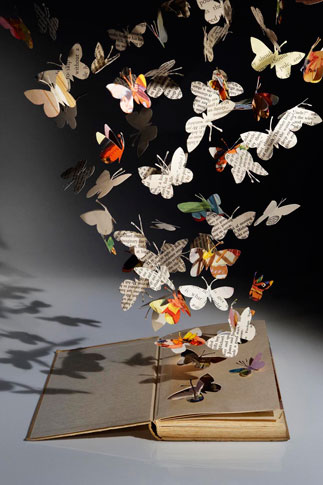 |
| 'Hope' 2009 |
Much like 'Hope', 'While you were sleeping' features a cloud of flying butterflies. The butterflies are escaping from a hanging dress, full of butterfly-shaped holes. The holes form a beautiful netting effect on the hanging material.
 |
| 'While you were sleeping' 2004 |
'The Secret Garden' is essentially, a larger-than-life Su Blackwell book sculpture, which viewers can interact with.
 |
| 'The Secret Garden' 2006 |
Her largest piece of work and another interactive piece, '1000 origami birds for Carly' is a room containing 1000 paper birds.
 |
| '1000 origami birds for Carly' 2003 |
The small and delicate nature of her work has made Su Blackwell a popular choice for advertising campaigns, in particular, those involving jewellery.
 |
| Vogue UK 2008 |
 |
| Cartier Store, Paris. 2009 |
 |
| Harrods Magazine 2009 |
http://www.sublackwell.co.uk/
Friday, 23 April 2010
Elizabeth Berrien.
Elizabeth Berrien is an artist who specialises in sculpting with wire. She mostly creates 3-dimensional animals and people but occasionally sculpts architectural objects and 2-dimensional illustrative images. She has a huge collection of awards to her name, and has worked for many companies, designers and architects around the globe. Work in the past has been created for; the BBC, Motorola, The Nature Company, Saatchi & Saatchi, Parc Des Topiares in Belgium, and Usui Design in Tokyo.
She works and lives in North California, in a farmhouse with several cats, dogs and horses. Her love of animals and the surrounding environment (which means she often encounters raccoons, foxes, and mountain lions) are her biggest influences for her mainly animal based work.
This intricate technique of wire sculpting is done with only her hands and a set of wire-cutters. As she begins a new sculpture, Berrien will surround herself with researched images of particular animal. She will start at the head, and weave downwards, following the lines of muscle and fur. Elizabeth Berrien refers to her own work as; '3-dimensional line drawings'.
She works and lives in North California, in a farmhouse with several cats, dogs and horses. Her love of animals and the surrounding environment (which means she often encounters raccoons, foxes, and mountain lions) are her biggest influences for her mainly animal based work.
This intricate technique of wire sculpting is done with only her hands and a set of wire-cutters. As she begins a new sculpture, Berrien will surround herself with researched images of particular animal. She will start at the head, and weave downwards, following the lines of muscle and fur. Elizabeth Berrien refers to her own work as; '3-dimensional line drawings'.
 |
| Elizabeth at work. |
 |
| Basset Hound. |
 |
| Phone wire Pelican. |
 |
| T.Rex. |
 |
| Pegasus at Louiseville International Airport, Kentucky. |
 |
| Spider Web Hanger. |
 |
| Ancestry Magazine. |
Monday, 26 October 2009
Quizimodo


6th October 2009; a rainy tuesday evening with nothing to do but throw ourselves into the Free for Arts Festival taking place in Manchester that week. So off we went to the art special of Quizimodo at Odder Bar.
We didn't win. Infact we didn't even come close as we came joint second to last. But we won an '80s style waist trimmer for our efforts, watched some Art Attack clips, and learnt some arty facts along the way. For example, contrary to popular belief that Van Gogh didn't sell any paintings during his lifetime, he actually sold one. Just the one though.
Instead of the usual drawing round of the quiz, there was a sculpture round. Each team was handed some plasticine and asked to create their finest 3-dimensional masterpiece. We produced a whole exhibition of underwater delights. This included my very own dragon-of-the-sea who was affectionately named Greg, as well as a button and a conch. It is a well known fact that buttons are found in the sea. Neither did we win this round but Quavers and biscuits at the end made everyone feel like winners.
Instead of the usual drawing round of the quiz, there was a sculpture round. Each team was handed some plasticine and asked to create their finest 3-dimensional masterpiece. We produced a whole exhibition of underwater delights. This included my very own dragon-of-the-sea who was affectionately named Greg, as well as a button and a conch. It is a well known fact that buttons are found in the sea. Neither did we win this round but Quavers and biscuits at the end made everyone feel like winners.
Subscribe to:
Posts (Atom)