Showing posts with label exhibition review. Show all posts

Tuesday, 2 August 2011

Sarah Greaves - Pulling the Threads. Exhibition Review.

The advertisements I saw for this exhibition really caught my eye. It fascinated me to see an exhibition of what mixed fine art installations with the traditional and detailed craft of embroidery. From 26th June - 3rd September, Sarah Greave has her debut solo show, 'Pulling the Threads', at Tameside Central Art Gallery, in Ashton Under Lyne.

Greaves describes herself as a mixed media artist who uses embroidery as graffiti on everyday objects such as doors, furniture, kitchen appliances and food. She explores identity, gender and personal thoughts about body image through the use of stereotyped objects and methods.

The image on the poster for the exhibition is her 'Carbs Toaster'. Two slices of bread with orange thread haphazardly stitched through the slices and 'Carbs' in green thread stitched into the side of the toaster in a feminine, swirling script. This work provokes the viewer to think about the many women who obsessively think about their food before eating it, if at all. The world we live in, according to Greaves, is body image orientated; perfection, celebrity role models and diets control women's thoughts in even the simplest tasks such as toasting a slice of bread.

'Carbs Toaster'

Another two food related images in the exhibition were of a banana and a square of chocolate. The banana had 'Good' stitched into it in brown thread and the chocolate had a red cross stitched across it. Fruit is of course a 'good' food when it comes to health, diets and consequently being slim and 'attractive' according to the society Greaves paints a picture of. And chocolate would be a bad food for those who want to diet and therefore a simple red cross shows that it shouldn't be eaten. Next to the images of the stitched food are the images showing the food once the thread and stitches have been pulled out. To me this demonstrates the rebellion against the labels society gives certain foods and that we should eat what foods we like, whether good for a diet or bad, free from pressure to only eat for body image.


A predominant feature of the exhibition was the selection of doors which had all been uniquely 'vandalised' with embroidered graffiti. The method of stitching and the use of such a feminine font are juxtaposed against the tools Greaves uses. Embroidery is a stereotypical female activity whereas the scale of the embroidery requires stereotypical male tools, such as drills.


All images from: http://sarahgreavesart.com/.

Saturday, 30 April 2011

Anish Kapoor - Flashback. Exhibition Review.

Anish Kapoor, Flashback Exhibition at Manchester Art Gallery. 29th April 2011


The first exhibition solely dedicated to the work of Anish Kapoor outside of London features sculptures and installations made from pigment, wax, stone and  stainless steel. Personally I think these materials collaborate well together, rather than fight for attention in the same room. The first sculpture I came to was 'Moon Shadow' 2005, made from wood, wax and an oil-based paint. I liked this sculpture as I felt it had a hidden drama to it; the wax and paint mixture made it look like it was still wet and had only been flung up onto the wall moments ago, the viewer is witnessing the few seconds before it falls from the wall and becomes a different piece of work entirely. The suspense and tentative nature of Kapoor's works makes them distinguished against other artist's.

'Moon Shadow'

"I don't wish to make sculpture about form - it doesn't really interest me. I wish to make sculpture about belief, or about passion, or about experience that is outside of material concern." Anish Kapoor 1981

'Turning the World Inside Out' 1995, made from stainless steel is a welcome piece amongst the sculptures made from wax and pigment. The reflective nature of the steel works well with the bold colours such as red, and yellow in the room. I feel the sculpture is quiet in form; smooth curves of steel seem humble against the spikes of the pigment and wax pieces. For me, the title of 'Turning the World Inside Out' seemed the most literal of all. The sculpture could be the world itself; turning inside out and imploding. Or it could be turning the world which surrounds the sculpture turning inside out. Due to it's reflective nature, it seems to be sucking inward the surrounding environment.

'Turning the World Inside Out'

'When I am Pregnant' by Kapoor, 1992, made from fibreglass, wood and paint, blurs the lines between work and gallery so much, this sculpture almost goes unnoticed. A subtle bump in the wall of the gallery, it is only really seen from the side, if this sculpture is looked at from straight on, it almost completely disappears as it is painted perfectly into the gallery wall

'Void' 1994, fibreglass and pigment, was another favourite of mine. A dome, which reminded me of half an egg-shell shape, had a deep purple exterior and a blackened interior. It is obvious to see that to get colour of this depth and intensity, pigment was Kapoor's only choice. The title of void, comes from the uncertainty of the blackened interior. When looking at this sculpture I studied it hard to decide whether it was a flat surface or if it did in fact curve inwards; the intensity of the colour makes this unbearably hard to figure out. With Kapoor's work, the voids envelope the viewer.

'Void'

'White Sand, Red Mullet, Many Flowers' 1982, mixed media and pigment, was what looked like the centre-piece of the exhibition. In the centre of the room, the sculptures looked like sandcastles of pigment, in red, yellow, and black. His use of pigment is clearly directly influenced by his Indian heritage and upbringing in India. The sculptures look like sandcastles that are precise and accurate in form. They look soft and crushable yet their form and structure appear strong. I like the visible tension between soft materials and solid forms.

'White Sand, Red Mullet, Many Flowers.'

Sunday, 10 April 2011

French Drawings, Poussin to Seurat. Exhibition Review.

French Drawings Exhibition, From Poussin to Seurat.
The National Gallery of Scotland Complex, Edinburgh.


Whilst in Edinburgh meeting the Intermedia students from Edinburgh Art College, I had a chance to visit some exhibitions around the city, one of which was the French Drawing Exhibition, in The National Gallery Complex, on Thursday 7th April.

After handing in my essay on Impressionism to Post-Impressionism (more specifically; the notion of a modern painter) only a few days earlier, I was really interested in visiting this show due to the massive amount of knowledge I now had on the subject. The exhibition was spread out amongst four rooms; the first was full of renaissance style drawings, mostly landscapes, and Italian influences were clearly visible in the early French work. This went onto two more rooms of similar styles, each with a mix of Italian-inspired landscapes and religiously allegorical images by classically trained old masters such as Ingres. As this is an exhibition of French drawings, many of the pieces on display are of a small scale and are simply studies for the larger, finished version. I preferred this as I love sketchbooks and seeing how artists develop their ideas and thoughts into finished pieces.

My favourite from the first few rooms of work, was the 'Study of Drapery' by Joseph-Ferdinand Lancrenon. I loved this simple drawing despite it only being an unfinished study for bigger and better work, I was just completely impressed with the sheer skill and talent it takes to perfect such three-dimensions with just pencil and chalk. I enjoyed the contrast in tones between the drapes of the sheet Lancrenon had drawn; the chalk highlights contrast well with not only the dark pencil lines depicting the folds but also the beige background he chose to draw on.

'Study of Drapery'

The fourth room in the exhibition was what I really came to see; this was full of the Impressionist paintings. There was work by Alfred Sisley, Paul Gauguin, Cézanne, Georges Seurat, Claude Monet and Berthe Morisot who as a female painter, stands amongst a whole gallery of male artists.

As one of my favourite artists anyway, Claude Monet's 'Haystacks: Snow Effect' was my favourite painting from possibly the whole exhibition. Despite it being a painting of snow and winter weather, the orange tones glowing underneath the blue and white of the snow, provide a radiating warmth to the piece. The deep blue and grey shadow of the haystacks shows subtle contrast close up, but when you take a few steps back to view the work, it becomes unbelievably three-dimensional. The grainy texture and visible brushstrokes capture the sense of rural landscape. Monet painted the Haystacks in Giverny countless times; as Charles Baudelaire at the time wrote, the modern painter paints the eternal qualities in our transitory world. Monet painted the haystacks over and over, capturing the eternal beauty found in fleeting moments, such as sunrise and sunset, snow and ice, and sunlight and rain.

'Haystacks: Snow Effect'

Another one of my favourites from the exhibition was the 'Seated Nude: Study for 'Une Baignade' by Georges Seurat. I liked this study because it was totally different from the paintings recognisable of Seurat but the figure is still identifiable as a figure from his very well known work of bathers sitting alongside a river.

'Seated Nude'


Images:
http://www.nationalgalleries.org/
http://www.nationalgalleries.org/whatson/exhibition/5:368/20240/20422
http://www.nationalgalleries.org/index.php/collection/online_az/4:322/results/0/5196/
http://www.nationalgalleries.org/collection/online_az/4:322/result/0/19740?initial=S&artistId=5052&artistName=GeorgesSeurat&submit=1

Sunday, 3 April 2011

osa/Merzen Exhibition and CUBElab.

Recently while I have been volunteering at the CUBE Gallery on Portland Street, there has been a change in exhibition and I have been invigilating the osa/Merzen exhibition based on the work of Kurt Schwitters and the CUBElab residency which is about the story of the water of Manchester and it's origins.

osa/Merzen at the CUBE Gallery is a gallery based installation and off site project which is changing the interior of the gallery space. Based on a term called "Merz" which is a method of arranging collected objects, a technique which refers to Kurt Schwitters way of working. There is a collage by Schwitters in the gallery throughout this project. The exhibition is part of the Merzman Festival in Manchester, which is showing exhibitions and events around the city inspired by Kurt Schwitters and his work in modern architecture and contemporary art. osa (office for subversive architecture) is developing the installation in the CUBE Gallery. Just like city development in Manchester, the installation and gallery space will transform in an ongoing process. All materials used in this are from Manchester and blur the lines between gallery space and installation (or frame and content).


In the CUBElab downstairs, artists Jason Minsky and William Titley are working together on 'Something in the Pipeline.' This is an artist residency made up of a gallery exhibition and a live outdoor performance. The artists are preparing for a journey from Haweswater in Cumbria to Heaton Park in Manchester. Mardale Green was a village in Cumbria which got flooded to create Haweswater, this was to keep up with the increasing demand for water in Manchester as the city grew. The artists are completing their research program in CUBE. The evidence from their field-trips will be shown; maps, drawings, plans, and historical documents will together document the story of the pipeline. The artists will build the Haweswater Reservoir complex and the lost village of Mardale Green out of Kendal Mint Cake. Also a water sample from the reservoir will be brought back to Manchester. They will be following the pipeline as closely as possible between Haweswater reservoir and Manchester communities for the 100 mile journey. The residency will end in a performance of their Kendal Mint Cake model of the Cumbrian location being flooded.

Saturday, 9 October 2010

Rafael Lozano-Hemmer.

Recorders Exhibition.

From Saturday 18th September 2010-Sunday 30th January 2011, Manchester City Art Gallery is showing an exhibition by Rafael Lozano-Hemmer called 'Recorders'.

Born in Mexico City 1967, Lozano-Hemmer studied chemistry before exploring the world of visual art. He now lives and works in Montreal, Canada and has won numerous awards in interactive and media arts.

Recorders is an interactive exhibition which solely depends on the interaction and participation of the general viewing public for a successful existence. Some of the installations records pulse, fingerprints, voice and images, all of the content is "crowdsourced". At first glance the work can be seen as open, an opportunity to get involved and play, yet on a deeper level it emits the predatory nature of modern society's surveillance technology.

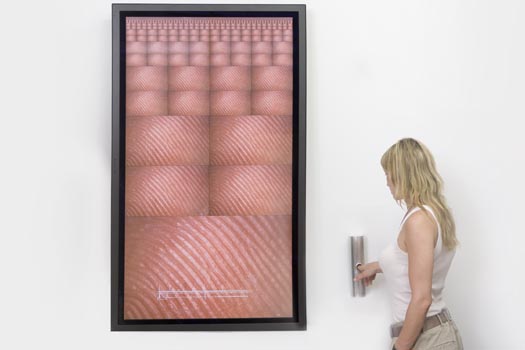
'Pulse Index' built in 2010, records fingerprints and heart rates. A fingerprint sensor takes the fingerprint and pulsates it to the beat of their heart rate. In a HD plasma screen display, it shows the last 509 participants, the most recent being the largest image.

'Pulse Index'

'Microphones' created in 2008 is made from several modified 1939-vintage microphones and loud speakers. The microphones records someones voice then playbacks the previous voice from a tiny loud speaker inside each of the microphones. The microphones combined with the loud speakers create an illusion of the microphones 'speaking back or replying' to the participant. The immediate previous voice may be played back or it could be one of 600,000 previous voices which Lozano-Hemmer intends to 'creates memories from these past echoes'.

'Microphones'

'33 Questions Per Minute', originally created for the 2000 Havana Biennial, is made up of a computer, 21 LCD screens and a program which generates 55 billion questions at a rate of 33 per minute. This impressive installation avoids repetition of the same question resulting in a lengthy 3000 years to get through all possible questions. Lozano-Hemmer's reasoning behind this piece is a criticism of state censoring. The amount of questions generated makes it difficult for authorities to censor critical content because they have no idea of the source, it could be human or it could be computer-generated.

'33 Questions Per Minute'

'Pusle Room' 2006, is an entire room filled with rows of incandescent light bulbs, and heart rate sensors on a metal stand. Viewers of this work hold onto the heart rate sensors until their pulse has been read. The first light bulb flashes to the pulse of their heart rate, pushing the last pulse read down the queue of bulbs so each bulb represents one person's heart rate.

'Pulse Room'

I found this electronic-based exhibition more enjoyable than other similar exhibitions I have seen. This is because of the viewers ability to 'change the works of art' through their involvement. This becomes more accessible to audiences, for example, science or sociology students may enjoy this exhibition as well as artists. I thought the written information about each piece of work was important, it provided facts and figures which made the work seem a lot stronger, it also gave the viewer contemporary themes to consider, such as questions about the relevance of technology in the 21st century.

http://www.manchestergalleries.org/whats-on/exhibitions/index.php?itemID=73

http://www.lozano-hemmer.com/

Thursday, 7 October 2010

Beyond Limits, Sotheby's at Chatsworth House.

An Exhibition Review: Beyond Limits Sculpture Exhibition at Chatsworth House.


Every autumn, Chatsworth House gardens become the location for ‘Beyond Limits, Sotheby’s at Chatsworth: A Selling Exhibition.’ This year there were 24 sculptures dotted around the grounds, some by new sculptors, and some Sotheby’s favourites such as; Damien Hirst, Lynn Chadwick and Marc Quinn who have been previously exhibited.

Lynn Chadwick had an impressive collection of four separate sculptures this year. All metal pieces, there was one named ‘Ace of Diamonds III’ and three representative of women. My favourite two were; ‘High Wind IV’ and ‘Ace of Diamonds III’. ‘High Wind IV’ shows a woman caught in a high wind by her horizontal sweeping skirt and hair. However, she is armless. This creates a streamlined figure, which I find emphasises the strong breeze. The bent knees also add to this, as if struggling to find footing against the gale. Every sculpture in this exhibition has its own carefully selected location to compliment the sculpture’s characteristics. This metal, grey-coloured piece stands out among a backdrop green. The rotating ‘Ace of Diamonds III’ really benefits from being situated upon water as the reflections almost become part of the sculpture. ‘Stairs’ is situated across the Ring Pond from ‘High Wind IV’. Another feminine sculpture, this one is a set of three steps with one woman walking up, and the other walking down and crossing on the middle step. Again, armless figures but they have triangular prisms instead of a human head. Chadwick’s final piece is titled ‘Three Elektras’ these are three figures, armless, triangular prisms instead of heads and three legs, similar to a stool. The sculptures are made from a grey-green metal finish, but part of the head and the front of the torso is shinier, polished gold. The angular features and soft shaped gardens in the Rockery create juxtaposition for the sculptures to really become fore-figures and stand out.

'High Wind IV'

'Ace of Diamonds III'

'Stairs'

'Three Elektras'

Thirteen out of the twenty four sculptures are human figures. Ju Ming had two sculptures, both bathing women named ‘Swimming’. I liked these figures; I found the poses they hold to be very life-like, one is lying down sunbathing and seems totally relaxed. They have prime position in the garden, just in between the Rockery and the Strid Pond. This immediately transports the sculptures to a tropical rainforest, two women in bathing suits, relaxing on rocks heated by the sun, and thinking about diving into the cool water below.

'Swimming'

'Swimming'

Manolo Valdes’ ‘Butterflies’ is of what is presumed to be a woman’s head, with hair made from, or a crown of jumbled butterflies. The stunning backdrop for this piece is the back of Chatsworth House. Although large and made from metal, the escaping butterflies give a slightly fragile and delicate appearance to the entire sculpture. The butterflies twisting in all directions catch the sunlight and provide lovely bright reflections.

'Butterflies'

'Butterflies'

‘Contemporary Terracotta Warriors’ is a group of identical sculptures by Yue Minjun, inspiration taken straight from the famous Terracotta Army which were found in pits near a burial ground in China’s Shaanxi province. The sculptures are in rows of four, stood on different levels of the Cascade allowing them to be viewed in its entirety as an installation or group. The expression is typical of Minjun’s work, an almost manic laughter; mouth wide open and eyes closed. However, they all have their hands covering their ears which turn the laughter into a cry or wail; this brings to attention the horrors of war.

'Contemporary Terracotta Warriors'

Another favourite is ‘Visitor’ by David Breuer-Weil. This is a large head of a man half immersed in the Strid Pond, this makes me think a huge man’s body is underneath the surface of the water, walking up to shore and about to come onto dry land. The Strid Pond is surrounded by a variety of plants and leaves, creating a jungle effect in my mind, a place where huge people and unusual animals could actually exist.

'Visitor'

A peculiar sculpture I found is Johan Creten’s ‘Why Does Strange Fruit Always Look So Sweet?’ Situated in the Rockery this is a man covered in what seems to be the ‘strange fruit’ from head to knees. This has made me think that perhaps a man was enticed by the strange but sweet looking fruit but the man gets covered by the fruit almost entirely when he tries to take some. This reminds me of the story of Adam and Eve being tempted by the serpent to eat fruit from the Tree of Knowledge of Good and Evil.  The strange fruit is sweet looking because of the temptation surrounding it; however if someone takes it there will be a bad consequence.

'Why does Strange Fruit always look so Sweet?'

A regular at the Beyond Limits Exhibitions at Chatsworth House, Damien Hirst this year has produced ‘Saint Bartholomew, Exquisite Pain’. This sculpture is the most religious. Saint Bartholomew was one of the Twelve Apostles of Jesus, a missionary in India and he died by flaying and crucifixion. Flaying is being skinned alive, preferably with the skin staying in one complete piece, Bartholomew the Apostle died a martyr hence Hirst’s title of ‘Exquisite Pain’. However Hirst has introduced a modern twist compared to the religious images from hundreds of years ago; instead of holding a knife like Saint Bartholomew is often depicted, he is holding a large pair of scissors. Considering the theme of pain, this sculpture has been carefully placed in the Sensory Garden.

'Saint Bartholomew, Exquisite Pain'

Near the Canal Pond, are two sculptures by Zadok Ben-David; ‘Leftover’ and ‘You Again’. They are two large copper coloured, 2-dimensional, Corten steel men. The men are incomplete silhouettes; they are made up of what appears to be tree branches. They seem lonely near the pond, two people contemplating life as they wander aimlessly around the calming water.

'Leftover'
'You Again'

Marc Quinn is another artist who has been involved in past Beyond Limits Exhibition. In previous years I have seen his ‘Sphinx’ sculpture of supermodel Kate Moss. This year he is showing two sculptures as one piece called ‘The Engine of Evolution’. At first appearances they are two large, completely white flowers. But the title proves they are more than a botanical installation. Each flower holds similarities to male and female genitalia, giving meaning to the title ‘The Engine of Evolution’. 

'The Engine of Evolution'

As you walk from the Canal Pond towards to House, you come across ‘Eve’ by Richard Hudson. The name and twisting curves suggest a womanly shape to this metal sculpture. I particularly like the many reflections on the glossy finish and I find it a particularly good photographic subject.

'Eve'
'Eve'

Barry Flanagan has exhibited at Chatsworth House before, with and without the Sotheby’s Exhibition. His ‘Large Mirror Nijinski’ is two hares posing, dancing almost, opposite each other. Flanagan’s work often features hares. The hares are placed in the Cottage Garden, each surrounded by their own circular bed of flowers which become part of their circular base.

'Large Mirror Nijinski'

‘Hungry God’ by Suboph Gupta is a large collection of aluminium pots and pans housed inside one of the garden’s greenhouses. Once again I like the use of polished metal for the twisted and unreal reflections, and the use of these items bring to thought kitchen utensils and food, in particular excessive food waste as the sculpture is like a tidal wave of waste.

'Hungry God'

'Hungry God'

Contemporary architect and furniture designer Ron Arad produced ‘Rod Gomli’, situated in the Rose Garden, the placement makes the chair seem it belongs in a terrace in a sunnier clime. The chair is like a raindrop shape, or perhaps a leaf or a pod, the natural shapes the chair conjures up makes me think that this chair belongs outside rather than in a living room. The lines throughout the chair really exaggerate the curves and shape of the whole sculpture.

'Rod Gomli'

'Rod Gomli'

‘Cubo I’ by Arnaldo Pomodoro, next to the Canal Pond is a large cube balancing on one point which appears to have cracked the square base. Each side of the cube has mechanical or technology details. This to me suggests that the cube has landed, as if dropped onto the earth from space, for it to crack the ground like this. This is suggestive of the advances in technology being so accelerated in recent years they might as well have landed here from somewhere else.
'Cubo I'

http://www.chatsworth.org/
http://www.chatsworth.org/whats-on/events/beyond-limits-sculpture-exhibition-in-the-garden

http://www.sothebys.com/

http://www.sothebys.com/app/live/event/EventEduDetail.jsp?event_id=29093